Published
- 6 min read
Pseudo-Demand and Low Desire

Preface
After nearly half a year of living in Canada, it is easy to find countless discussions online about differences compared to life in China. Education, healthcare, and pensions are the three commonly discussed areas.
However, the most significant difference I have gradually come to feel does not belong to any of these categories. It emerged slowly, but once recognized, it became very clear: I have entered a state of low material desire.
First Arrival in Canada
When I first arrived, I brought what I considered “rotation clothes” for different seasons, along with items I assumed would be difficult to obtain locally.
Having lived independently before, I thought I had sufficient experience distinguishing necessities from quality-of-life improvements. However, this time the environment itself had fundamentally changed, making many of my previous assumptions less applicable.
Take the concept of “rotation clothes.” Growing up in Xinjiang, where the climate is dry, clothes would dry within one or two days, or even overnight in winter due to heating. The idea of needing many sets for rotation was not strongly established.
In Chongqing, however, the situation was completely different. Clothes could take several days, even a week, to dry due to humidity. This often led to situations where I “had nothing to wear,” simply because nothing was dry. As a result, I accumulated large quantities of similar clothing.
In Canada, this concept becomes almost irrelevant. With a dryer, clothes are ready to wear shortly after washing. The drying process also removes lint, improving the wearing experience. For months, I found myself wearing the same set of clothes daily, washing bedding once a week with minimal effort.
This led me to realize that I had brought far too many clothes. At one point, I even considered rotating outfits just to justify the number I had brought. That realization made me pause. It exposed not only unnecessary consumption, but also the flawed reasoning behind it.
Clothing is one aspect. Another is online shopping.
In China, e-commerce platforms like Taobao and JD offer an overwhelming variety of products. Even without searching, one can scroll endlessly. Purchasing shifts from “do I need this?” to “where will I put this?” The abundance of choices, combined with recommendation systems, creates a continuous loop of consumption.
In contrast, Amazon presents far fewer options. Searching for a product yields only a handful of primary choices. There is little need to compare dozens of nearly identical items. The focus shifts to functionality: finding something that works and solves the problem.
The key difference is the absence of “browsing.” There is no extended, aimless exploration. If measured, the time I spend purchasing on Amazon is likely a fraction of what it was on Taobao.
For specific needs, physical stores like Home Depot or Canadian Tire provide an even more direct experience: search, locate, purchase, leave.
These observations are not unique to me. However, they prompted me to reflect deeply on the underlying causes.
Pseudo-Demand
Through comparison and reflection, I arrived at a conclusion: most of my past “needs” were in fact pseudo-demands.
They were not genuine necessities, but constructs shaped by marketing, environment, social influence, or self-justification.
When considering whether to purchase something, several factors influence the decision: necessity, cost-performance, preference, and impulse. Among these, necessity should be the primary factor.
Without necessity, there should be no purchase. This is evident in obvious cases: one would not buy elementary school exercise books or exam preparation materials without a clear purpose.
However, once even a minimal sense of necessity is introduced, it can be amplified by other factors. This is where pseudo-demand operates.
Marketing strategies often begin by creating or revealing a perceived need. Once established, other factors, such as price, preference, or impulse, drive the purchase.
In many cases, we are not responding to genuine needs, but convincing ourselves that a need exists.
Scarcity and Psychological Imprint
From a broader perspective, human history has been shaped by scarcity. Periods of stability and abundance are relatively recent.
In societies that have experienced prolonged scarcity, this leaves a psychological imprint. This influence extends into consumption behavior.
One manifestation is hoarding. Even in the absence of real scarcity, people accumulate goods as a form of psychological security. This is particularly evident in non-perishable items, such as clothing or household products.
Minor perceived needs, combined with price sensitivity and impulse, lead to accumulation. Many items remain unused, stored, or eventually discarded.
The experience of recent global events further reinforced this behavior.
In this context, pseudo-demand is not isolated. It is amplified by deeper psychological factors rooted in historical conditions.
Understanding Products Through Demand
To analyze this further, I constructed a simple model of products based on demand characteristics.
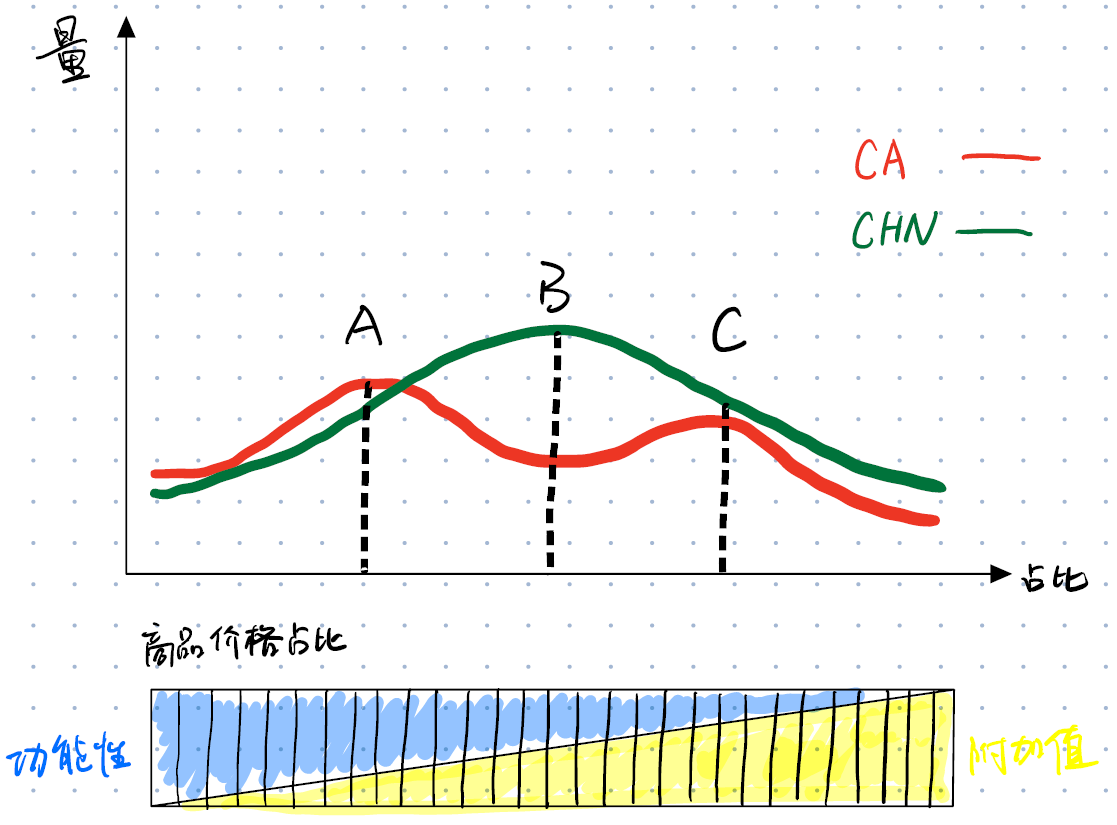
In this model:
-
The horizontal axis represents the proportion of functionality versus added value within a product’s price.
-
The vertical axis represents the overall quantity of such products in the market.
In a simplified assumption, a product’s price consists of these two components.
On one end are purely functional products, such as basic tools or consumables. On the other end are products dominated by added value, such as collectibles or luxury goods.
My observation is that:
-
In China, the distribution resembles a normal curve, with the largest volume of products located in the middle, where functionality and added value are balanced.
-
In Canada, the distribution appears bimodal, with peaks at highly functional products and highly value-added products.
This explains a common perception: fewer product varieties in Canada, yet sufficient availability for practical needs.
In China, many products cannot be clearly categorized. Functional items often include significant added value, driven by cultural factors such as presentation and social expectations.
Packaging, for example, becomes a key method of increasing perceived value. In some cases, packaging costs exceed the product itself.
This creates a market where added value is often inseparable from functionality, leading to purchases that are not strictly necessary.
Shopping Behavior
Before coming to Canada, my family visited an outlet mall to purchase functional clothing. Within minutes, I found myself categorizing items as either functional or fashion-oriented.
We ultimately could not find suitable items and instead went to Decathlon, which provided products closer to our functional requirements.
Even with reduced exposure to local marketing platforms, alternative channels still exist. Recommendation-based content continues to influence choices.
However, over time, repeated mismatches between expectation and reality led to a gradual reassessment of actual needs.
This process, although subtle, reinforces the shift toward reduced consumption.
Low Material Desire
The state of low material desire is partly shaped by environment. Fewer choices and longer decision cycles naturally reduce consumption.
However, this does not lead to emptiness. Instead, it creates space for other pursuits.
Time and attention shift toward activities that were previously difficult to sustain, such as writing or building projects.
In this sense, reduced material desire does not represent loss, but reallocation.
End.