Published
- 4 min read
What Influences Our Path Toward “Success”

Toward “Success”: Factors, Models, and a Way to Think
There are many factors that influence one’s path toward “success.” Here, “success” does not refer to a fixed standard, but rather to the state each individual hopes to reach.
Some say “the college entrance exam determines your entire life,” while others claim “attitude determines everything.” How should these factors be weighed? Can they be analyzed and compared in a way that offers practical insight—especially for those who are about to become, or already are, parents?
This article originates from a discussion among several friends. What I find valuable is not the conclusion—since that is inherently subjective—but the process: how the problem was analyzed, and how a simple model gradually took shape.
One day, Dr. Sun, exhausted after a night shift, shared a reflection about the college entrance exam in our group chat. That triggered the following line of thought.

Dr. Sun said:
“For most children from ordinary families, the college entrance exam is a crucial opportunity to change their life trajectory.”
I generally agree with this view. But meaningful discussion should not end with a simple “yes.” So I extended the topic and first defined a baseline:
We define “success” as follows: for individuals born between 1987 and 1990, from working-class families, having a stable job, being financially independent, able to marry and raise children, and living without significant financial pressure. This state is assigned a score of 80.
With this baseline, we begin analyzing influencing factors.
Listing and Structuring the Factors
We started by listing all possible factors:
-
College entrance exam (Gaokao)
-
High school entrance exam (Zhongkao)
-
Personal effort
-
Personality
-
Family conditions
-
And others
This led to the initial diagram:
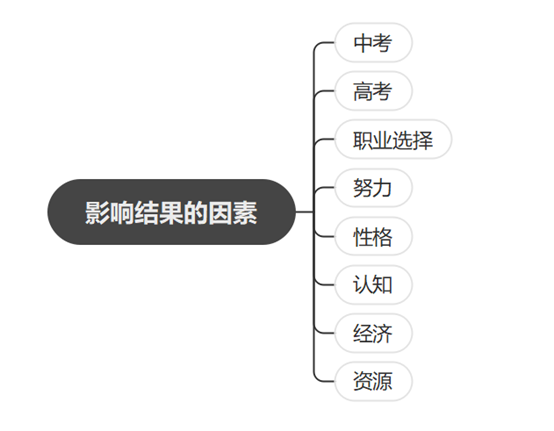
Directly assigning weights to all factors was difficult. So I proposed grouping them into categories:
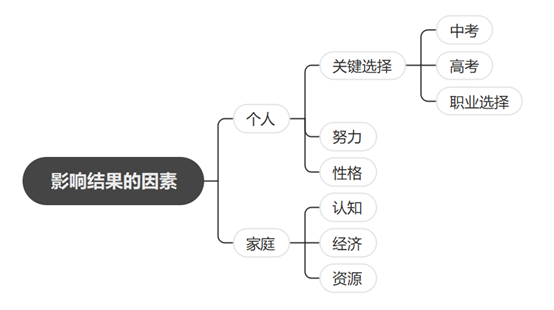
Assigning Weights
Next, we assigned rough weight proportions within each category—purely based on intuition.
For example, between individual factors and family factors, we initially estimated:
-
Individual: 20%
-
Family: 80%

These numbers are subjective, but that is acceptable. The goal is not precision, but structure.
After discussion, we reached a set of weights that most participants agreed upon:
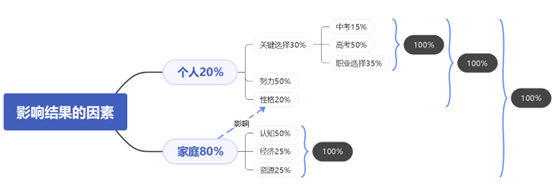
Weighted Calculation
The key step in this discussion was applying hierarchical weighting.
Each lowest-level factor inherits weights from all levels above it.
For example:
-
Zhongkao accounts for 30% within “Key Decisions”
-
“Key Decisions” accounts for 30% within “Individual Factors”
-
“Individual Factors” accounts for 20% within the overall model
So the final weight of Zhongkao becomes:
15% × 30% × 20% = 0.9%
At this stage, someone argued that Zhongkao might be even more important than Gaokao. We adjusted accordingly:

After recalculating all factors, we obtained:
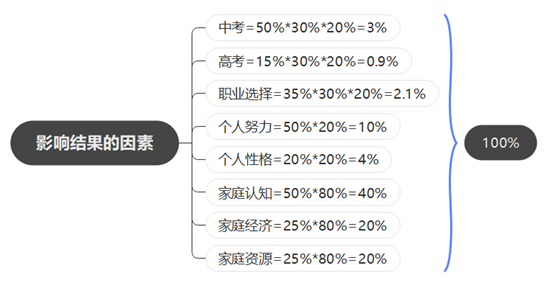
Interpretation
My immediate reaction was:
Is the family factor really that dominant?
After reflection, I formed this view:
-
If the benchmark is 80, then exceeding 80 depends more on family factors.
-
Falling below 80 depends more on individual factors.
-
As the benchmark lowers, individual factors gain relative importance.
-
As the benchmark rises, family factors become increasingly decisive.
In other words, without strong family support, individual effort alone has a limited ceiling.
Model Adjustment
Based on this, I adjusted the weight between individual and family factors from:
- 20% / 80% → 40% / 60%
The recalculated result:
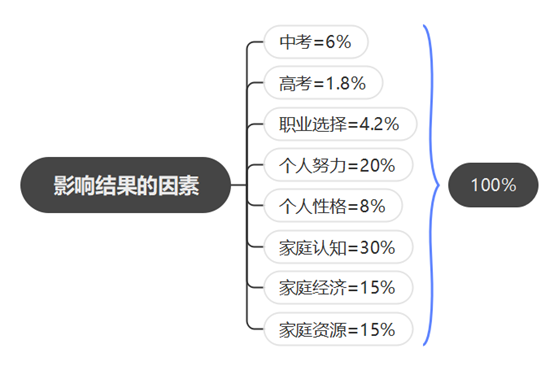
This outcome felt more balanced. If each factor performs reasonably well, it corresponds to an “80-point life.”
Further Reflections
This model still misses an important dimension:
Time.
The influence of factors is dynamic across life stages.
-
In youth, family influence is stronger.
-
In adulthood, individual factors become more dominant.
-
Some factors, like effort, persist throughout life.
Another common reaction is blame:
“Now I know why I’m not successful—my family wasn’t good enough.”
This interpretation misses the point.
The purpose of analysis is not complaint, but reflection:
-
Where can individual factors be strengthened?
-
How can one become a more positive influence for the next generation?
Two Final Points
-
Analysis as a Habit
In both work and life, problems should be examined systematically.
The process may take days or weeks, but clarity emerges gradually.
The “control variable method” learned in school often applies directly to real-world situations.
Many problems resolve themselves through sustained thinking. -
Results Are References, Not Truths
Analytical results should not be treated as absolute rules.
Like medical test reports that state: “Interpret results in clinical context.”
That means: always adapt conclusions to real conditions.Or, as I prefer to put it:
Instead of distorting yourself to fit someone else’s framework, treat their ideas as raw material, and build your own.
End.